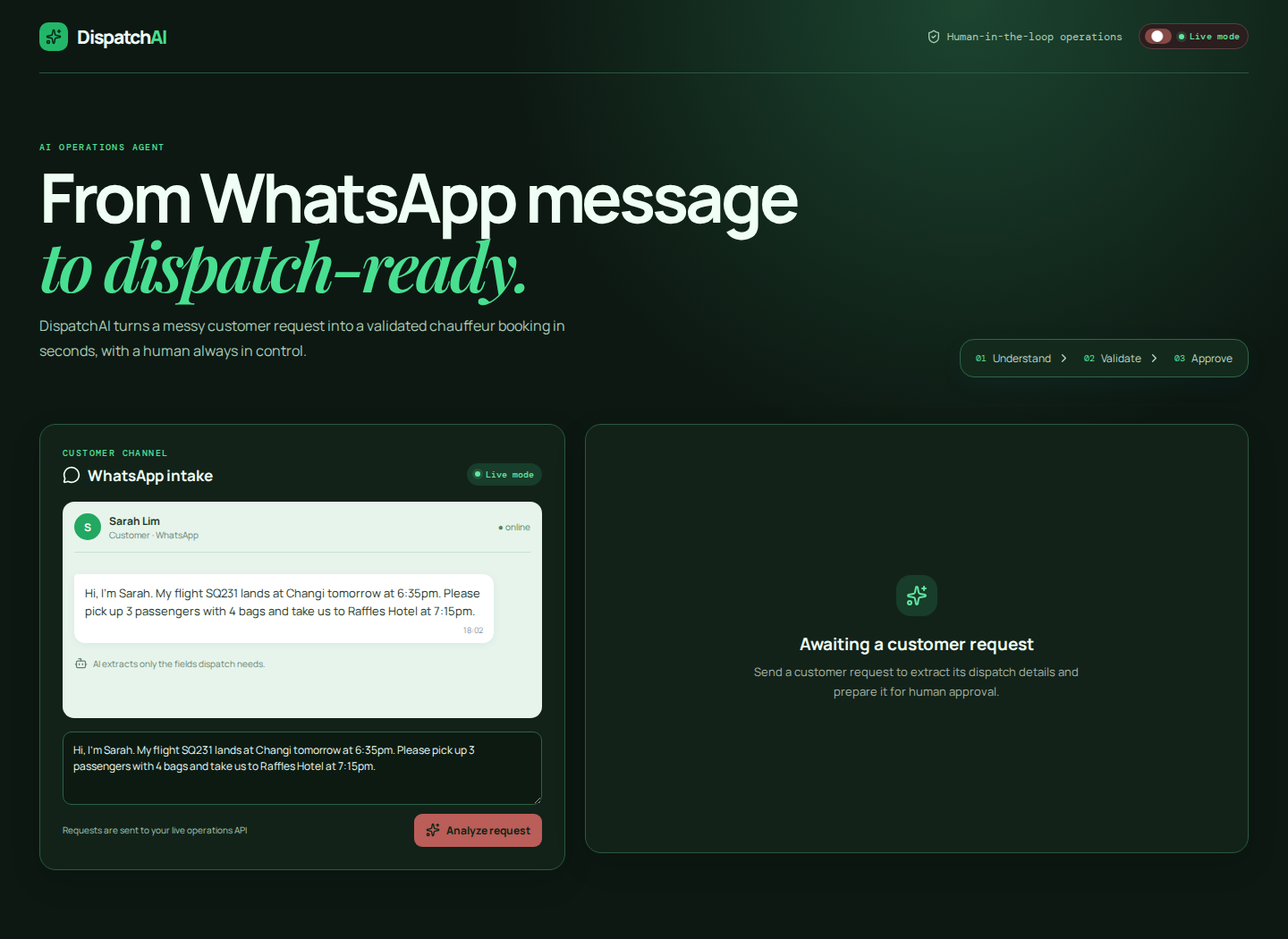
DispatchAI was the project I built during OpenAI Build Week, and it also marked my very first hackathon. I wanted to challenge myself by building something that solved a real operational problem instead of creating another chatbot. While exploring real-world business workflows, I became interested in the repetitive process of handling chauffeur booking requests through WhatsApp. Dispatchers often need to read lengthy conversations, extract booking details, validate addresses, check flight information, and manually create bookings. That inspired me to build DispatchAI—an AI Operations Agent that turns conversational customer messages into structured booking drafts while ensuring every booking is reviewed and approved by a human dispatcher.
What DispatchAI Does
- Accepts WhatsApp-style customer booking requests.
- Uses OpenAI GPT-5.6 to extract structured booking information from natural-language conversations.
- Captures customer details, booking type, pickup and destination, travel date and time, flight number, passenger count, luggage, and special requests.
- Validates Singapore addresses using the OneMap API when running in Live Mode.
- Retrieves flight information through a mock flight service.
- Highlights missing information, confidence scores, warnings, and follow-up questions for dispatchers.
- Creates booking drafts in a Pending Approval state for human review.
- Supports both Demo Mode for offline demonstrations and Live Mode with OpenAI, OneMap, and Supabase integrations.
What I Learned
Participating in my first hackathon was an exciting experience. Working under time constraints taught me how to quickly transform an idea into a functional application while making practical engineering decisions. More importantly, it reinforced that AI delivers the greatest value when it assists people instead of replacing them.
- Designed prompts that convert conversational messages into structured booking data.
- Learned how to separate AI reasoning from factual validation using external services.
- Built a human-in-the-loop workflow where dispatchers remain responsible for the final booking decision.
- Integrated multiple APIs into a single operational workflow.
- Created automated documentation by using Playwright to capture screenshots of the application.
- Produced the project demonstration video with FFmpeg for the Devpost submission.
- Experienced the complete lifecycle of planning, building, documenting, and presenting a hackathon project.
Framework & Technologies
Frontend
- React
- TypeScript
- Vite
- Tailwind CSS
- shadcn/ui
Backend
- FastAPI (Python)
- Supabase PostgreSQL
AI & External Services
- OpenAI GPT-5.6
- OneMap API
- Mock Flight API
Development Tools
- Git
- GitHub
- Playwright
- FFmpeg
- Codex
- ChatGPT
Final Thoughts
Although DispatchAI began as my first hackathon submission, it became much more than a weekend project. It gave me the opportunity to explore how large language models can be combined with external services to solve practical business problems while maintaining human oversight. If I continue developing this project, I would like to integrate WhatsApp Business, live flight providers, driver assignment, and operational monitoring to make it even more useful for chauffeur dispatch teams.
Comments